Working for a Design Firm vs. Starting Your Own Studio
I’m going to start this article with being very transparent, I do have a strong bias based on my own opinions and experiences but I am going to do my best to give you the honest reality of the 2 paths. I don’t want to pretend to be neutral when I’m not, so while my opinions are my opinions, I will keep the facts accurate.
I’ve only had a boss once in my life for 2 years when I worked at the bank right out of university. I’ve been self employed ever since I left my short stint at the bank in 2014. So when I made the decision to get into interior design, it wasn’t even a question that I would work for a firm, have a boss, clock in and clock out, it just wasn’t the right fit for me. And listen, if you’re currently working a 9-5, I am not saying you’re doing it wrong, everyone has their preference but it just wasn’t for me. And frankly, even if I wanted to work at a firm, there probably wasn’t a firm in all of North America that would’ve hired me because I had zero experience and I didn’t go to design school.
Did I do it the “right” way? Well… yes and no because there is no one “right” way to do this. Ultimately you have to find what the best right way is for you so I’m writing this article to compare the differences between working for a firm vs. starting your own studio so that you can make up your own mind.
Working for a Firm - “The Learning Lab”
If you’re freshly out of school and the thought of starting your own studio is too daunting, then working for a firm is an excellent option. My recommendation is to use this experience as a real world classroom and absorb every ounce of information you can get your hands on. Here are a few things you should keep your eyes open for:
How the firm is run
The visions and values
The design process from start to finish
Contracts and business operations
Everyone’s role on the team
How your colleagues handle projects, clients, and mistakes
These are all things that you can’t get from school so be intentional and absorb it all.
Now for the comparison. Let’s dive into the pros and cons of working for a firm, starting with the pros.
There is a built in mentorship structure which allows you to learn how a real business is run from the inside.
You’ll get exposure to the full design process, contracts, and business operations without having to figure it out alone.
It’s much lower risk because you’re getting a steady paycheck while you build skills and experience.
You don’t have to go out and find new clients which is the most challenging part about running any business.
There is a clear (but slow) career ladder to follow.
Intern → Design Assistant → Junior Designer → Designer → Senior Designer → Partner
Moving on to the cons of working for a firm.
Although there is a level of built in mentorship, I have talked to countless designers who have worked for firms and had terrible experiences ranging from lack of mentorship to straight up toxic work environments so make sure to go in with eyes wide open.
The starting pay is low and income potential is capped, averaging around $40k-$50k depending on your location and experience/skill level
Promotions are slow because there are only so many spots for each position, especially in a smaller boutique firm.
You get little to no creative control especially if you’re just a minion (meaning, anything below senior designer level)
There is zero ownership over how the business is run.
Starting Your Own Studio - “The Entrepreneur’s Journey”
Now let’s talk about starting your own studio which isn’t all sunshine and roses either. If you want to skip the firm or maybe you’ve already worked at a firm and now want to start your own studio, fair warning, it is a roller coaster ESPECIALLY if you don’t have a mentor or support system in place.
As you already know, I skipped the firm and dove right into starting my own studio and because I didn’t have any prior design knowledge, I was extremely lost and a little (okay, a lot) scared. I had nobody to hold my hand and reassure me that what I was doing was right or very wrong.
*It’s important to know what to do but it’s just as important, if not more important to know what NOT to do which you wouldn’t know unless you learn through trial and error (like I did), or hire a mentor (like me! Shameless plug)*
The pros and cons between a firm vs. studio are basically reversed. These are some of the reasons I chose to build my own studio instead of working for a firm
Full control of your time and location. I travel 2-3 months every year with zero impact to my business and when I don’t feel like working, I don’t.
The income potential is uncapped. I’m only a 6 figure designer but plenty of studios hit 7, even 8 figures.
Since this is YOUR studio, you have full creative control. As long as the client is game, you can design whatever your little heart desires.
Complete freedom over who you work with. If you don’t want to take on a client for whatever reason, all you have to do is not take that client on. Simple!
You’re building something that is YOURS. You can’t underestimate the power this has over your purpose, fulfillment, and overall satisfaction of your life.

Now, like I said earlier, this sounds amazing but it isn’t ALL good. The reality is that there are countless challenges with having your own studio.
Big girl (or big boy) responsibilities. When you run your own business, you are wearing all the hats. You are obviously the lead designer but you’re also the one going out and finding business, sourcing materials, communicating with reps, contractors & trades, the accountant/bookkeeper, and the list goes on and on. Every business owner has experienced some level of burnout from trying to wear too many hats.
Your income level, especially when you’re just starting out, will be highly unpredictable.
No built in mentor or support system unless you pay for a coach (ahem)
If this list hasn’t deterred you and you’re still curious about starting your own studio, here are a few tips from someone who’s just a little bit ahead of you.
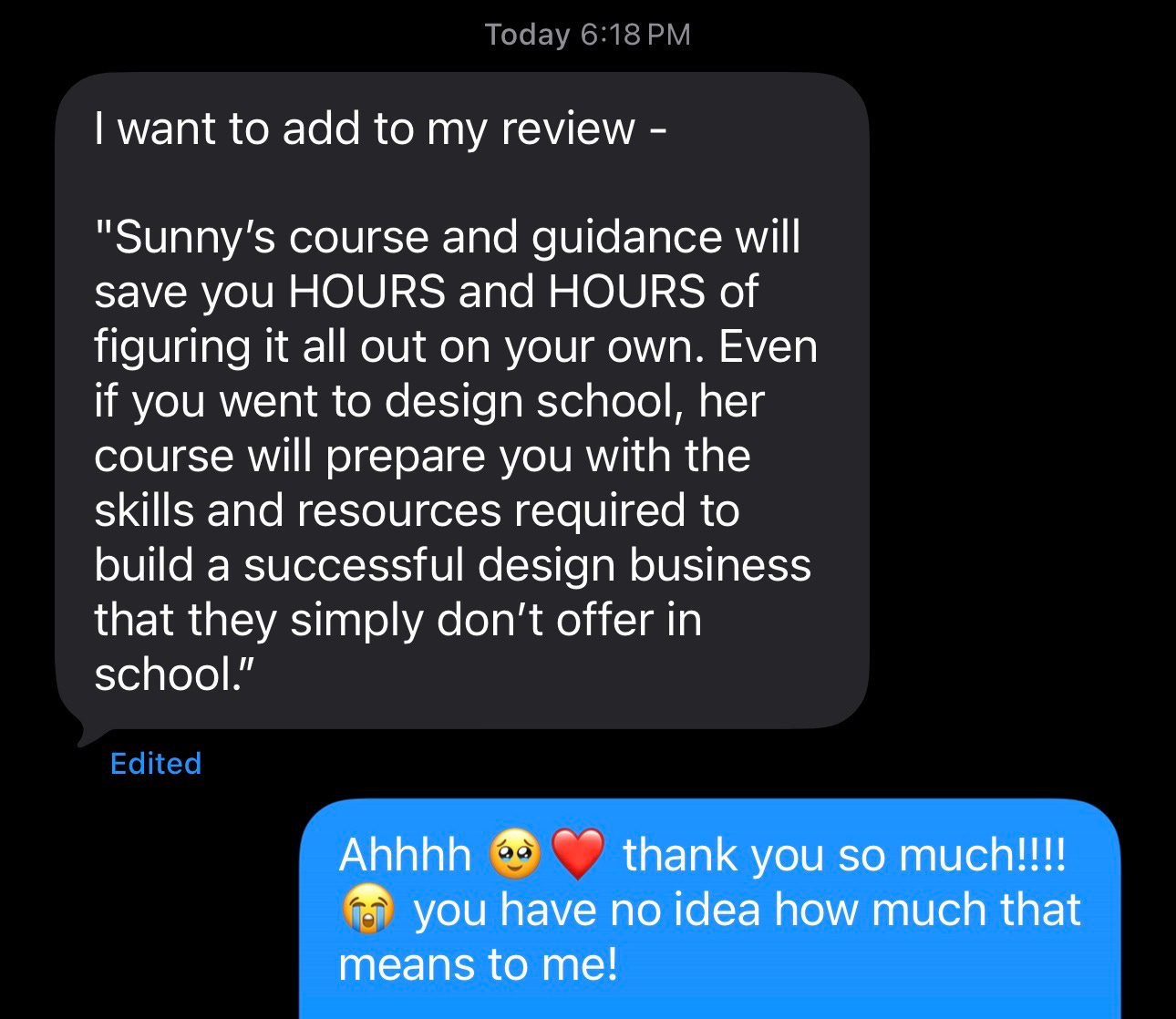
First and foremost, you have to get yourself a mentor. I know that sounds self serving since I am an interior design coach but it’s the god honest truth. Frankly, you don’t even have to work with me but I’m telling you, the best way to shortcut your learning process is to learn from someone who’s done exactly what you want to do.
Secondly, you have to learn how to say no. I know that seems counterintuitive but vetting clients carefully and being brave enough to turn the wrong ones down will strengthen your business in ways you might not expect. The wrong clients will drain your time, energy, and profit.
And third, you have to know your numbers inside and out. Remember, you’re taking on big girl responsibilities now and this means you have to check your finances regularly and don’t avoid looking at what’s coming in, going out, or overdue.
And regardless of which option you choose, you have to learn how to be a master communicator in all ways. This means you know how to talk to clients, contractors, trades and even to the 8 billion people on the internet. Talk about what you do publicly, even if you’re working for a firm, having a personal brand never hurt anyone and at the end of the day, you are your own best marketing tool and no one is coming to promote you.
So here’s my honest final answer: there isn’t a right path, just the right path for you. They’re both challenging for basically polar opposite reasons so you have to pick your poison and pray it doesn’t kill you. The right one depends on your goals, values, and lifestyle. I chose the harder, scarier route because that’s who I am, but plenty of incredible designers built beautiful careers by climbing the ladder at a firm first. Whichever one you pick, pick it on purpose instead of by accident.
If you’re leaning toward starting your own studio, I built the Aspiring Interior Designers’ Blueprint to be the mentor I didn’t have. My students are building their businesses faster than I did because they’re skipping the years I spent flailing alone. I hope I’ll see you in my Aspiring Interior Designer community soon!
